SMART INSIGHTS
for better connection
Understand your wounds.
Transform your relationships.
Heal your body.
Ending generational trauma — one relationship, one diagnosis, one life at a time. AttachWise is building the first AI platform that maps the unconscious wound patterns driving both relationship dysfunction AND chronic disease vulnerability. Using voice-based assessment and the proprietary TypeStack framework, we move psychiatry and medicine from reactive treatment to proactive prevention.
Relationships
health
A Broken System
The Problem — $50 Billion Exposed
Every year, over 750,000 American marriages end in divorce. Half of all children will experience their parents’ separation. The downstream costs — therapy, lost productivity, healthcare, addiction, incarceration — exceed $50 billion annually.
But the cost doesn’t stop at relationships.
The same attachment wounds that drive divorce also drive chronic disease. Insecure attachment produces decades of autonomic nervous system dysregulation — chronic fight-or-flight that elevates cortisol, inflammatory cytokines, and neuroinflammatory burden. Published research shows this burden accelerates neurodegenerative disease, autoimmune conditions, cardiovascular disease, and chronic pain.
The reactive model has failed completely. We treat the divorce after the damage is done. We treat the disease after the symptoms appear. AttachWise intervenes upstream — at the wound itself.
The Discovery
Meet the founder

Erik Smith, MD
Founder & CEO of AttachWise
Your 5-Year-Old Chooses Your Partners
The Discovery: After 20 years in medicine — delivering over 5,000 babies, watching half those families dissolve — and surviving my own divorce, I discovered something that changed everything:
People don’t consciously choose partners. Their wounded nervous systems do.
By age 5, children develop unconscious templates for love based on their primary caregivers. These templates become the invisible algorithm that drives partner selection for life. We don’t fall in love — we fall into pattern recognition.
The Breakthrough: I mapped my own relationship history and found I had married the same psychological pattern — twice. The same core personality structure. The same attachment wounds. The same instinctual drives. Different women, identical unconscious selection.
When I looked at my mother’s pattern, the correlation was unmistakable. I had spent my adult life trying to earn love from partners who carried the same psychological signature as the caregiver I worked hardest to connect with as a child.
This isn’t just my story. It’s everyone’s story.
And now it’s predictable.
The Deeper Discovery: But the pattern doesn’t stop at relationships. The same wounded nervous system that compulsively selects incompatible partners also runs chronic autonomic dysregulation — the biological foundation for disease. When I began working with patients with ALS, autoimmune conditions, and chronic illness, I found the same attachment wounds, the same autonomic patterns, the same unconscious templates. The wound doesn’t just choose your partners. It shapes your health.
Two Missions, One Framework
Precision Patterns. Better Outcomes.
Understand your wiring, predict relationship and health risks early, and follow a personalized path to regulation and real healing.
Help people understand their unconscious patterns — why they’re attracted to who they’re attracted to, and what that attraction actually means.
Identify high-risk pairings before commitment. A “green light / yellow light / red light” system for relationships based on deep psychological compatibility, not surface preferences.
For existing relationships: match couples with therapists trained in their specific attachment patterns and personality dynamics. Precision therapy, not trial-and-error.
TypeStack-profile individuals to identify chronic autonomic dysregulation patterns linked to disease vulnerability. Flag at-risk configurations for monitoring and early intervention — potentially decades before symptoms appear.
Daily AI-guided nervous system regulation personalized to your TypeStack profile. Morning and evening practices that shift your autonomic baseline from sympathetic overdrive to parasympathetic healing. The AI in Your Pocket.
Somatic Experiencing, stellate ganglion block, ketamine-assisted therapy, and psilocybin-guided deep work — matched to your specific wound pattern and timed to neuroplasticity windows. Healing the wound, not just managing symptoms.
the heart of Attachwise
The Technology: TypeStack — Your Complete Wound Map
TypeStack is the proprietary assessment framework at the heart of AttachWise. It integrates three validated psychological systems into a single composite profile that predicts both relational behavior AND autonomic dysregulation patterns:
Your core personality architecture across three intelligence centers (head, heart, gut). In partnership with Katherine Fauvre, creator of the Tritype methodology with over 200,000 validated assessments.
How you bond: secure, anxious, avoidant, or disorganized. Formed in childhood, running on autopilot in every adult relationship — and in your nervous system.
Your drive hierarchy: self-preservation (body/safety), sexual (intensity/merger), social (belonging/status). Your secondary variant reveals where your wound lives.
a map of WHERE your wound lives
When you combine these three systems, you get something no single framework provides alone: a map of WHERE your wound lives, HOW it expresses in relationships, and WHAT chronic stress pattern it’s been running in your nervous system since childhood.
The voice-based assessment
The voice-based assessment analyzes how you narrate your relational history — not what you say about yourself on a questionnaire, but how your nervous system organizes the story of your life. That’s where the real data lives.
The Discovery That Changed Everything: Your Wound Doesn’t Just Choose Your Partners. It Shapes Your Health.
In early 2026, while working with a patient diagnosed with ALS (amyotrophic lateral sclerosis), I discovered that the TypeStack framework designed for relationship compatibility revealed something far more significant: the same attachment wound driving his relationship patterns was also driving the chronic autonomic dysregulation contributing to his neurodegenerative disease.
The evidence chain is published and peer-reviewed:
1. Insecure attachment → Chronic autonomic dysregulation Decades of sympathetic nervous system overdrive. Measurable. Documented. Running since childhood.
2. Chronic autonomic dysregulation → Neuroinflammation Elevated cortisol, pro-inflammatory cytokines, microglial activation in the central nervous system.
3. Neuroinflammation → Disease In ALS: glutamate excitotoxicity destroying motor neurons. In autoimmune conditions: loss of immune self-tolerance. In cardiovascular disease: arterial inflammation. Same upstream cause, different downstream expression.
The insight: If we can identify the wound pattern through TypeStack assessment, and heal the chronic autonomic dysregulation through targeted parasympathetic intervention, we may be able to modify disease trajectory — or prevent disease from manifesting in genetically susceptible individuals.
This is not alternative medicine. This is psychoneuroimmunology — the published, peer-reviewed science of how psychological patterns create biological conditions.
“Right now, a person diagnosed with ALS goes home with a prognosis and a prescription. No one asks about their childhood. No one assesses their attachment style. No one connects the neuroinflammation destroying their motor neurons to the unresolved wound they’ve been carrying since they were five years old. We want to change that.”
Testimonials, as authentic endorsements from satisfied customers, serve as potent social proof, significantly inspiring trust in potential consumers.

Testimonials, as authentic endorsements from satisfied customers, serve as potent social proof, significantly inspiring trust in potential consumers.

Testimonials, as authentic endorsements from satisfied customers, serve as potent social proof, significantly inspiring trust in potential consumers.
win the week
Daily Tools for Healing
Win the Week is the consumer-facing companion to AttachWise — a daily AI-guided platform for nervous system regulation, attachment wound healing, and disease trajectory modification.
What it does:
- Morning check-in: body scan, parasympathetic activation personalized to your TypeStack, intention setting
- Evening reflection: pattern tracking, micro-win logging, personalized reparenting messages
- Weekly review: functional status tracking, Win the Week declaration
- Monthly deep dive: parts check-in, wound letter, progress visualization
Who it’s for: Anyone healing from attachment wounding — whether that wound is showing up in your relationships, your health, or both.
The origin story: Win the Week was co-created with James Finlen, an ALS patient who is documenting his reversal journey in real time. His insight: “Just slow it” became “stop it” became “reverse it.” Winning the week is how you get there.
The Opportunity
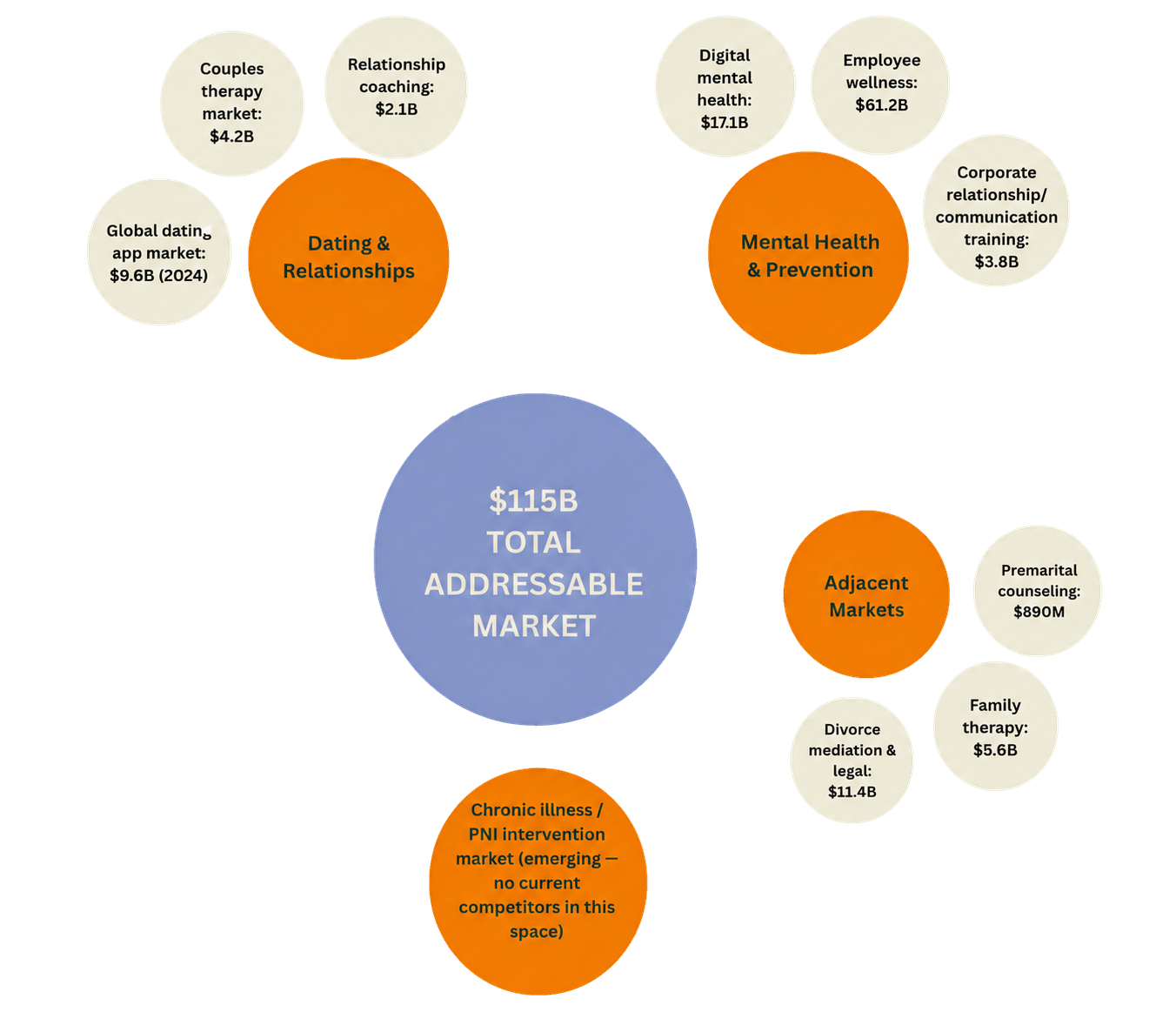
The Market: A Multi-Billion Dollar Opportunity Across Verticals
Our Entry Point: B2C assessment platform → B2B therapist tools → Partnership/licensing with dating platforms → Corporate wellness programs → Healthcare system integration → Chronic illness screening and intervention (NEW)e “reverse it.” Winning the week is how you get there.
the moat
What Makes AttachWise Defensible
TypeStack is the proprietary assessment framework at the heart of AttachWise. It integrates three validated psychological systems into a single composite profile that predicts both relational behavior AND autonomic dysregulation patterns:
TypeStack integrates three validated systems through AI-powered voice analysis. Partnership with Katherine Fauvre’s 200,000+ assessment database. No public AI tool can replicate this.
Every user interaction generates data correlating personality/attachment profiles with relationship outcomes and health trajectories. The dataset grows more valuable with every user. Classic data moat.
Published, peer-reviewed research connecting TypeStack to disease outcomes. Case reports, pilot studies, and eventually the paradigm paper. Evidence that takes years to build.
Ready to See Your Pattern?
The TypeStack assessment takes 60 minutes. You’ll speak about your relationships, your childhood, and your life — and our AI will map the unconscious patterns your nervous system has been running since you were five.
What you’ll learn:
- Your complete TypeStack profile (Tritype + Attachment Style + Instinctual Variant)
- Where your wound lives and how it expresses
- Your relationship compatibility patterns
- Your autonomic dysregulation signature
- Personalized recommendations for healing